Growing an online store is not simply about increasing the advertising budget. At a certain point, results depend on decisions that affect the whole business: who to target, which market to enter, which sales channel to choose, how to localise the offer, how to deliver orders profitably and how to measure performance.
That is why an e-commerce business often needs more than a performance marketer, SEO specialist or website developer. It needs a coherent growth strategy built around the product, margins, customer journey and scaling goals.
An e-commerce strategist or consultant usually leads this work, supported by specialists in marketing, technology, marketplaces, logistics and local regulations. A full-cycle e-commerce agency can bring these roles together and turn the strategy into practical execution.
Koshman Ecom works with B2C and B2B brands across strategy, website development, Shopify, SEO, AI search optimisation, advertising, international marketplaces and e-commerce consulting. Before work begins, the team defines business goals, priority markets and KPIs, then supports the project from analysis through launch and scaling.
When does an online store need a growth strategy?
A strategy becomes necessary whenever a business is making an expensive decision or trying to connect several sales channels. Common situations include:
- sales have stopped growing even though traffic is increasing;
- the store depends too heavily on one marketplace or advertising channel;
- the brand wants to expand from Ukraine into the EU, the US or other markets;
- the owner is choosing between Shopify, a marketplace and an owned store;
- advertising brings visitors, but the website loses them before checkout;
- the company wants to add B2B sales, wholesale distribution or a new product category;
- the team needs a clear plan with budgets, timelines, owners and KPIs.
Without a strategy, entering a new market often becomes a series of disconnected experiments. A business translates its website, opens a marketplace account and launches ads, but cannot explain which customer need it serves or whether each order is profitable.
Who should build the strategy?
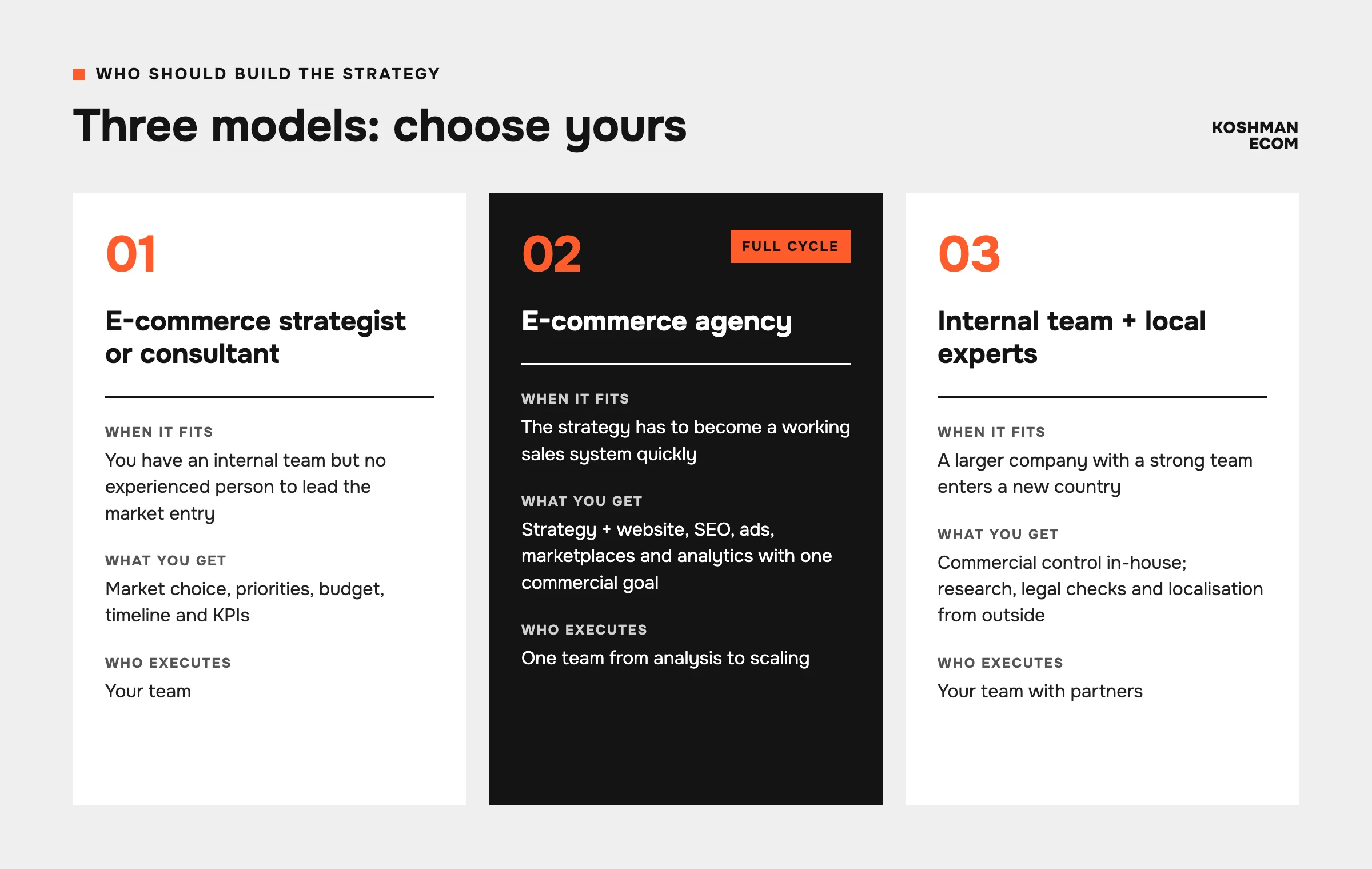
1. An e-commerce strategist or consultant
This person connects business objectives with marketing and sales decisions. They should be able to assess the product, customers, competitors, margins, existing channels and operational constraints.
A strategist should be able to answer questions such as:
- Which market has enough demand and a manageable level of competition?
- Which product and offer should be tested first?
- Is the business ready for a marketplace, an owned store or both?
- What needs to be fixed before buying more traffic?
- What budget and timeline are realistic?
- Which metrics will show that the market entry is working?
A consultant is particularly useful when a company already has an internal team but lacks an experienced person to lead the market-entry process.
2. An e-commerce agency
An agency is a good fit when the strategy needs to become a working system quickly. It can bring together a strategist, developer, SEO specialist, performance marketer, marketplace manager, designer, copywriter and analyst.
The value is not simply in having more people involved. Their decisions need to serve the same commercial goal. Product pages, advertising messages, analytics, checkout, email flows and marketplace listings should all support the same brand positioning.
Koshman Ecom works as one team responsible for the path from strategy to sales. Its services include growth strategy, Shopify, website development, repeat sales and LTV, SEO, international marketplaces, Pinterest, YouTube, advertising, branding and e-commerce consulting.
3. An internal team supported by local experts
Larger companies may build their strategy internally. Even a strong internal team, however, often needs local expertise when entering a new country.
Local specialists can validate the language, customer expectations, competitors, search behaviour, payment habits, delivery options and marketplace rules.
A practical model is to keep commercial leadership inside the company while using external partners for market research, legal and tax checks, localisation, technology and launch execution.
If you already know that entering a new market requires more than a single contractor, start with a short conversation about your business, product and goals. We can help you identify which data to check first and where it makes sense to begin.
What should an e-commerce growth strategy include?
A good strategy is not a long presentation full of generic marketing ideas. It is a decision-making document that explains what the business will do, why it will do it and how it will measure the result.
1. Business and product analysis
Start with the product, not the sales channel. Review the range, margins, average order value, repeat-purchase potential, returns, seasonality, production capacity and delivery costs.
Then identify the strongest commercial proposition. A product may sell well in the home market but be difficult to export if it is fragile, expensive to ship, regulated or difficult to explain in another language.
2. Customer and competitor analysis
Describe the customer by need and buying situation, not only by age and country. What problem are they solving? What alternatives are they comparing? What proof do they need before buying?
Competitors should not be assessed by price alone. Analyse their offers, product pages, reviews, delivery terms, returns policy, content, organic visibility, marketplace presence and advertising messages.
3. Choosing a target market
A good market combines demand with operational feasibility. Compare countries using criteria such as:
- search and marketplace demand;
- competitor strength and price levels;
- product-market fit and cultural relevance;
- delivery time, cost and return complexity;
- payment and customer-service expectations;
- VAT, consumer-protection and product-certification requirements;
- the ability to create local-language content and support.
The largest market is not always the best first market. A smaller country with stronger product fit, simpler logistics and lower competition may give the business a faster learning cycle.
4. Channel and platform strategy
Choose the sales channel according to the product and the stage of the business.
Marketplaces can provide demand and trust more quickly. Etsy often fits handmade, vintage and design-led products. Amazon can be more suitable for standardised products and larger volumes. eBay or Alibaba may fit other B2C or B2B models.
An owned store gives the brand more control over customer data, content, conversion and repeat sales. Shopify can be a practical option for a brand that needs an international storefront and a scalable e-commerce foundation.
A combined model is often the strongest: marketplaces help validate demand, while the owned store builds the brand and direct customer relationships. The important point is to compare the full economics of each channel, not just the platform fee.
5. Go-to-market plan
A market-entry plan should show what happens before, during and after launch.
Before launch, prepare the offer, localised listings, photography, analytics, payments, delivery, store policies, customer support and basic content. During launch, it is usually better to test a limited number of products and messages than to spread the budget across the whole catalogue.
After launch, analyse search terms, conversion, returns, customer questions, advertising efficiency and signals of repeat purchase.
Every test should be based on a hypothesis. For example: “Customers in this market will choose the larger bundle if the product page explains the cost per use.” That is more useful than the general decision to “run more ads.”
How should logistics be planned?
International businesses usually consider two starting models.
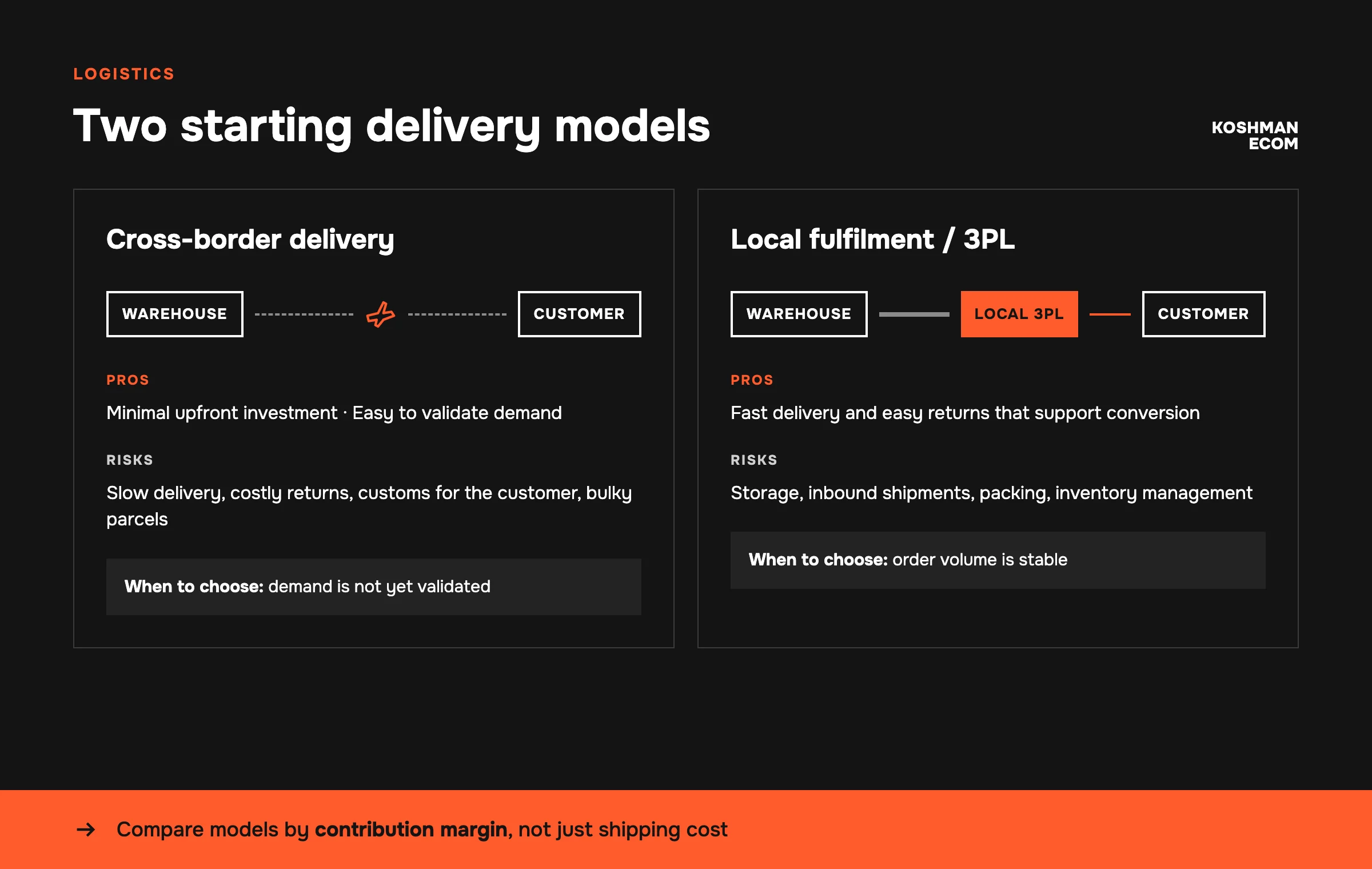
Cross-border delivery from the existing country
The business keeps inventory in its current warehouse and ships each order internationally. This model generally requires less upfront investment and is suitable when demand has not yet been validated.
It can become expensive when delivery is slow, returns are frequent, parcels are large or customs charges create friction. Delivery promises should be based on real carrier conditions, not a best-case scenario.
Local fulfilment or a 3PL partner
Inventory is placed closer to customers in a local warehouse or with a third-party logistics provider. This can speed up delivery and returns, but it adds costs for storage, inbound transport, packing and inventory management.
Local fulfilment becomes more attractive when order volume is stable, delivery speed affects conversion or products are too expensive to ship individually from Ukraine. For some categories, it is also worth comparing Amazon FBA with an independent 3PL partner.
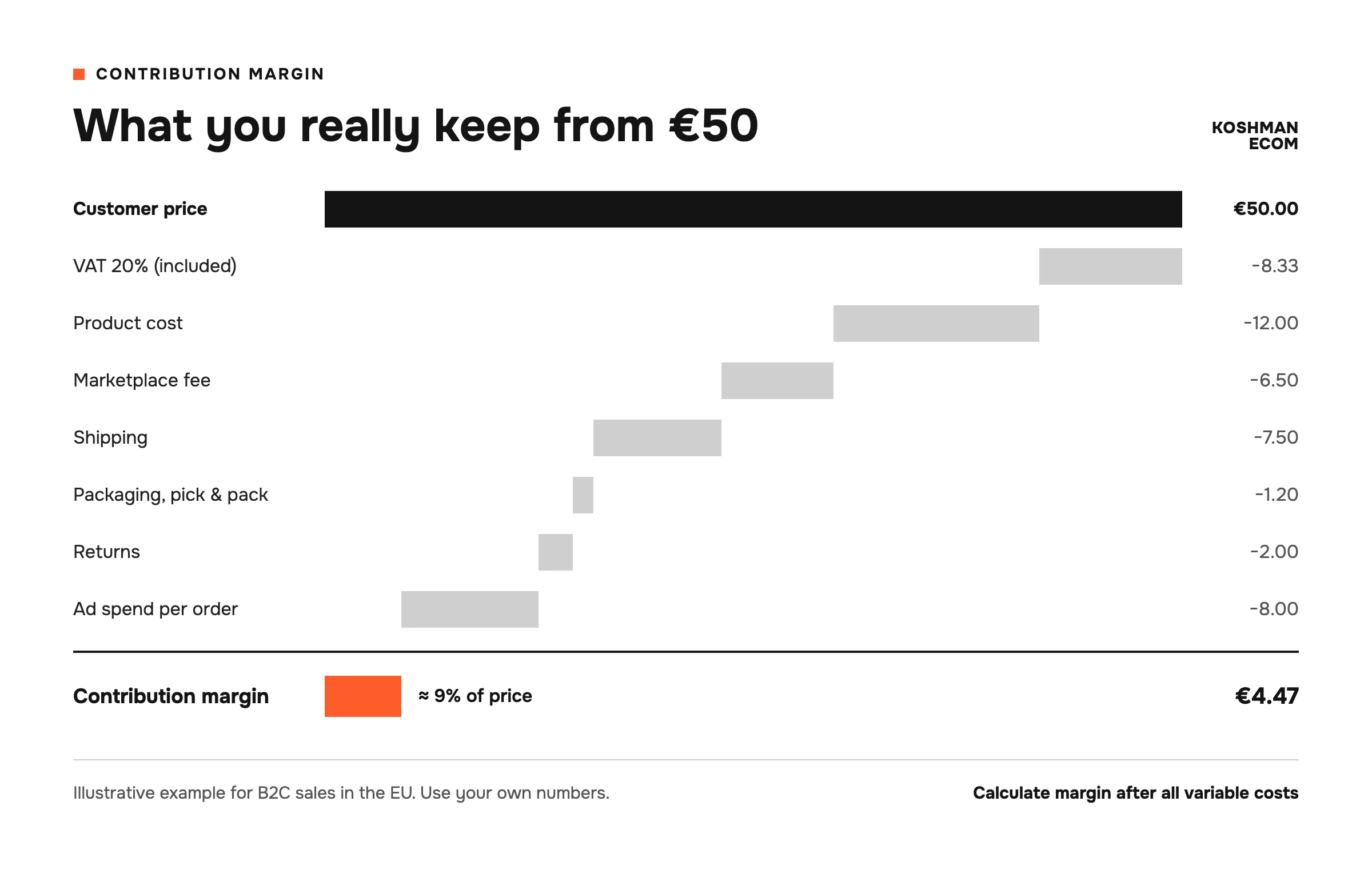
The strategy should be based on contribution margin—the margin left after variable costs per order—not on shipping cost alone. Include warehousing, pick-and-pack, packaging, returns, customs, tax administration, marketplace fees and customer support.
Which legal and tax questions need to be checked?
International sales should not be launched on marketing assumptions alone. Before scaling, obtain advice for the specific country and product category.
For B2C sales in the EU, the One Stop Shop regime can simplify VAT reporting and payment for eligible cross-border transactions. The Import One Stop Shop also exists for distance sales of imported goods valued up to €150. These regimes have a defined scope and exceptions, so confirm whether OSS or IOSS applies to your product and fulfilment model.
An online store must also clearly provide information about the seller, product characteristics, total price, delivery, payment, returns and the right to withdraw from the contract. EU distance-selling rules also require the customer to understand clearly at checkout that placing the order creates a payment obligation.
If the store collects names, addresses, phone numbers, account details, analytics data or marketing consent, GDPR needs to be considered. Customers should understand who processes their data, why, on what legal basis, who may receive it and how long it will be stored. Consent must be specific, informed and withdrawable when consent is the legal basis for processing.
This section is a planning checklist, not legal advice. VAT registration, product certification, consumer protection, packaging requirements and data transfers depend on the country, product and operating model.
What team is needed to enter a new market?
In a small business, one person may cover several functions. The responsibility for each area should still be clear.
- Owner or commercial lead: approves the market, investment level, offer and acceptable risk.
- E-commerce strategist: turns research into priorities, a roadmap, budget and KPIs.
- Localisation specialist or native-language editor: adapts the language, product argumentation, descriptions and tone of voice.
- Performance marketer: tests acquisition channels and manages the relationship between spend, revenue and margin.
- Marketplace manager: manages listings, marketplace SEO, advertising, inventory and customer communication.
- Developer and CRO specialist: improves the store, checkout, analytics and conversion path.
- Operations, tax and legal advisers: review delivery, returns, VAT, privacy and product requirements.
An agency does not replace the owner’s product knowledge. It adds structure, specialist capacity and an external perspective, especially when internal decisions are based on assumptions.
How do you know whether the strategy is working?
International growth should not be measured by traffic or revenue alone. Track indicators across the entire funnel:
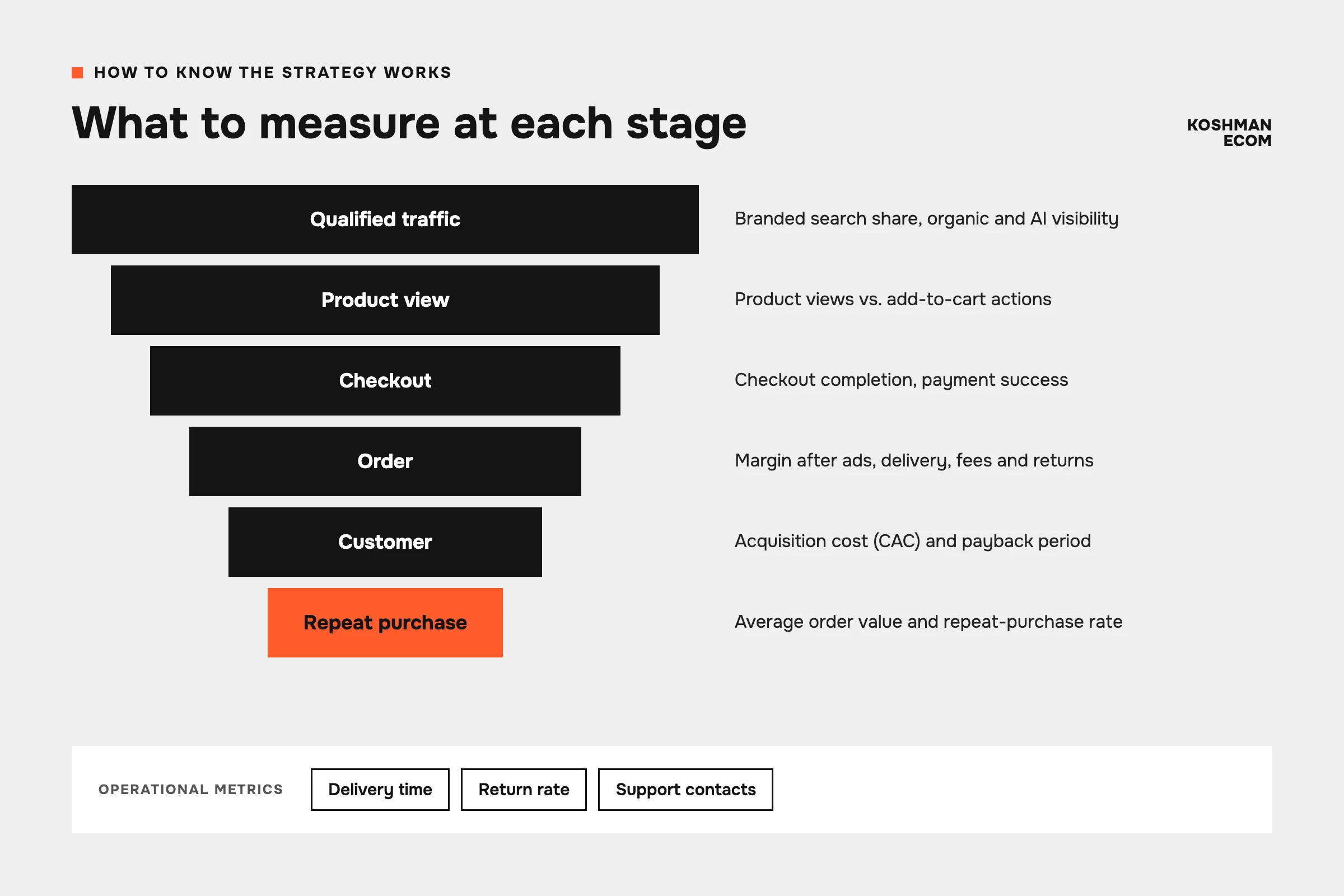
- qualified traffic and share of branded search;
- product views compared with add-to-cart actions;
- checkout completion and payment success;
- margin after advertising, delivery, fees and returns;
- customer acquisition cost and payback period;
- average order value and repeat-purchase rate;
- delivery time, return rate and customer-support contacts;
- organic and AI-search visibility for important product and category queries.
AI-search visibility should support, not replace, classic SEO. Clear product information, useful expert content, structured data, consistent brand mentions and real customer reviews help both search engines and AI assistants understand the business. Koshman Ecom combines AI-search optimisation with traditional SEO.
A practical 90-day market-entry plan
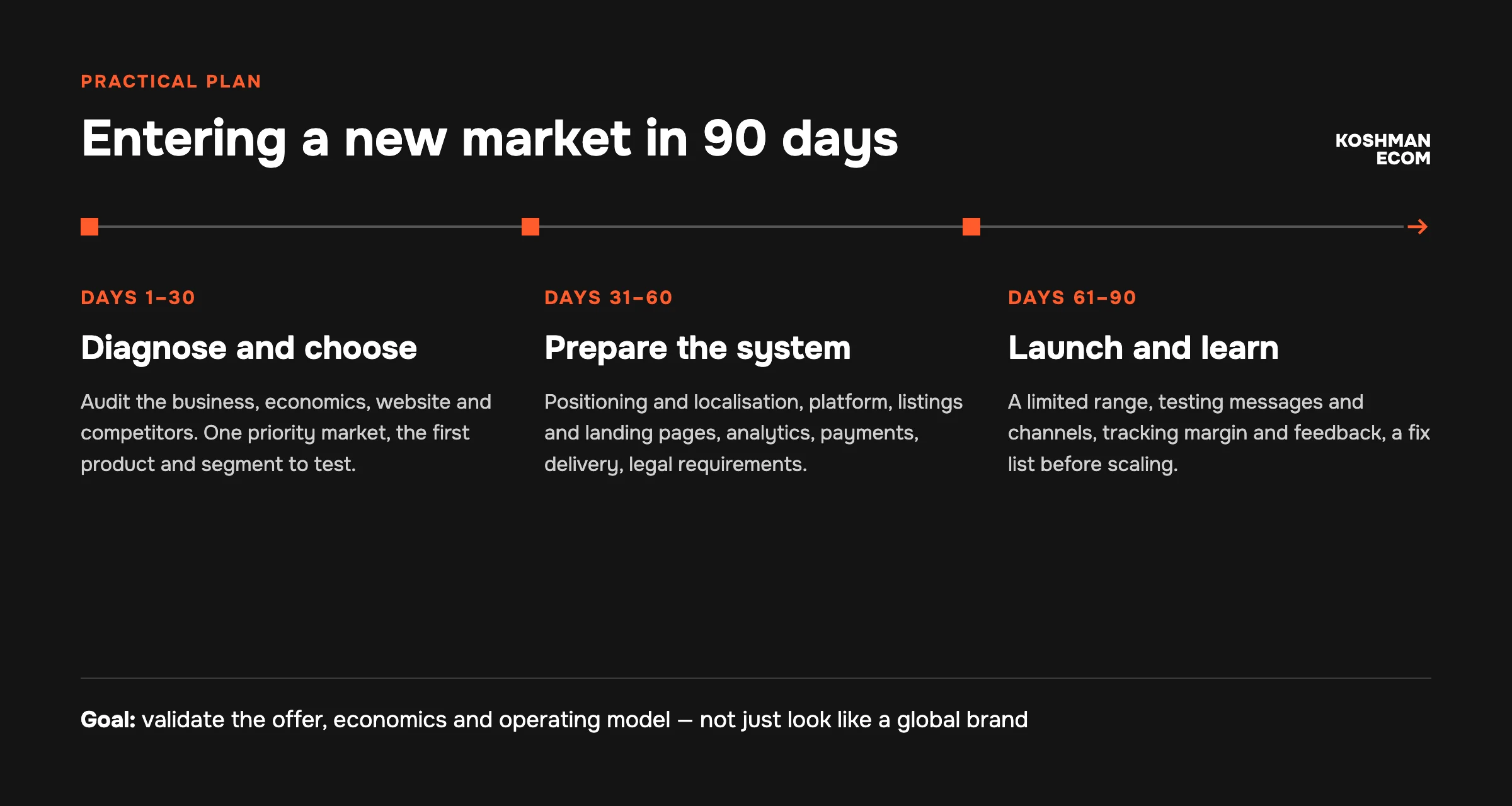
Days 1–30: diagnose and choose. Audit the business, product, economics, website, competitors and current channels. Select one priority market and define the first product and customer segment to test.
Days 31–60: prepare the system. Finalise the positioning, localise the offer, choose the platform, prepare listings and landing pages, configure analytics, verify payments and delivery, and review legal and tax requirements.
Days 61–90: launch and learn. Launch a limited range, test several messages and acquisition channels, monitor margin and customer feedback, then document what needs to be fixed before scaling.
The goal of the first 90 days is not simply to look like a global brand. It is to verify whether the offer, economics and operating model work in the selected market.
Conclusion: who should build the plan?
For most growing online stores, the strongest option is an e-commerce strategist or full-cycle e-commerce agency that can connect business analysis, market research, channel selection, technology, marketing, logistics and compliance planning.
Choose a partner who asks about profit, operations and customer experience—not only about the advertising budget. A good plan should leave you with clear priorities, a testable launch model, defined owners and measurable goals.
If you are choosing between a new market, a marketplace and an owned store, Koshman Ecom can start with a strategic audit or a free consultation. The team works with B2C and B2B brands in Ukrainian, English and Slovak and helps businesses enter the EU, US and other markets.
Discuss your e-commerce growth strategy with Koshman Ecom →
Frequently asked questions
What is an e-commerce growth strategy?
It is a prioritised plan for increasing profitable online sales. It connects the product, target customers, markets, channels, website, marketing, operations, budget and KPIs.
Should I start with Etsy, Amazon or Shopify?
It depends on the product, demand, margins, brand goals and fulfilment model. Etsy often fits handmade and design-led products, Amazon can fit standardised products and larger volumes, while Shopify gives a brand more control over its own store and customer relationships. In many cases, a combination works best.
How much does an e-commerce consultant cost?
The cost depends on the scope: an audit, a market-entry plan, implementation or ongoing support. An accurate proposal requires a short brief covering the product, current sales, target market and required services.
Is translating a website enough to enter a new market?
No. Localisation also includes positioning, product arguments, search terms, images, pricing context, payment methods, delivery promises, returns and customer support.
What is the difference between SEO and AI-search optimisation?
They overlap but are not identical. SEO helps a website become visible in traditional search engines. AI-search optimisation also focuses on clear, trustworthy, structured and contextual information that AI assistants can understand and use in their answers.
Do I need a local warehouse from the start?
Not always. Cross-border delivery can be a sensible way to validate demand. A local warehouse or 3PL becomes more attractive when demand is stable or delivery speed and returns materially affect conversion and margin.

Specialises in international e-commerce, sales-launch strategy and the use of AI in business processes. With more than five years of e-commerce experience, he helps B2C and B2B brands enter new markets in a structured, sustainable way.